01
Content warningReal violent crimes; victims are named. Help: findahelpline.com. More
This page describes real violent crimes and names the victims. Victims come first; we leave out details that serve only sensationalism. Help: free helplines in your country at findahelpline.com; in an emergency call 112 (EU) or 911 (US).
Peter Kürten
Peter Kürten, born 26 May 1883, Mülheim am Rhein (now Cologne)
A moulder and a thief and arsonist with many convictions from Düsseldorf, convicted of nine murders and seven attempted murders. He committed his first murder in 1913 in Mülheim near Cologne, and the other eight in 1929 in Düsseldorf and on its outskirts. He killed five girls, three women and one man. He strangled his victims, stabbed them with scissors or a dagger and, from the autumn of 1929, struck them with a hammer. The press called him the Vampire of Düsseldorf. For months the police believed another man’s false confession and searched for several perpetrators. He was caught on 24 May 1930 after one of the survivors led the police to his building and his wife, to whom he had confessed, told the police about a meeting with him. Psychiatrists found him criminally responsible. He was executed by guillotine on 2 Jul 1931 in Cologne.
- 9
- murdered, sentenced to death for all the murders● Fact
- 7
- attempted murders in the judgment, for which he received an aggregate 15 years’ penal servitude● Fact
- 79
- crimes he himself dictated after his arrest, numbered from 1 to 79, including arson● Fact
- 5
- girls among the nine victims, as well as three women and one man● Fact
5Fact
6Disputed
2Theory
79 of 79claims have a source
18sources, 1 of them primary
02 / 17 / Timeline
From birth to the file found in 2023
Events: 51 / 1883–2023
- 01
Life
1883 - 02
Crimes
1893 - 03
Life
1894–97 - 04
Capture, trial, sentence and aftermath
1899–04 - 05
Crimes
1913 - 06
Capture, trial, sentence and aftermath
1913 - 07
Life
1923–25 - 08
Crimes
1925–291925Attacks and fires
CrimesFrom 1925 to 1928 he attacked women and set dozens of fires, and received short sentences for minor offences. The details are given only by Berg. [1]
- 09
Capture, trial, sentence and aftermath
1929 - 10
Crimes
1929 - 21 Aug
Attacks in Lierenfeld
CrimesIn a single night he attacked three people with a dagger; they survived. The details and names are given only by Berg. [1]
- late September
The first sketch
CrimesHe dropped a sketch of Maria Hahn’s grave into the letterbox of the Düsseldorfer Stadtanzeiger, with no response. Stated only by Steiling. [7]
- 11
Capture, trial, sentence and aftermath
1929 - 12
Crimes
1930 - 30 Apr
Attack in the Grafenberger Wald
CrimesHe attacked a woman with a hammer; she survived with skull injuries. Stated only by Berg. [1]
- 13
Capture, trial, sentence and aftermath
1930–23 - 9 Jun
Article in TIME
Capture, trial, sentence and aftermathTIME wrote about the case under the headline “Vampire Coachman” and described him as a retired coachman. [13]
- 1965
Le Vampire de Düsseldorf
Capture, trial, sentence and aftermathRobert Hossein made a film about the case and played the lead role himself. [18]
- 1974
Book of documents
Capture, trial, sentence and aftermathElisabeth Lenk and Katharina Kaever published a collection of documents on the case, reissued in 1997. Stated by LTO. [2]
03 / 17 / Victims first
Named victims
Named victims: 9 / Survivors: 7
The list contains the nine murdered people for whose murder Kürten was convicted in April 1931. The names are given by the book of the forensic doctor Karl Berg and by Biography.com, and for most victims also by WEB.DE, LTO or Steiling. He killed eight victims in Düsseldorf and on its outskirts in 1929, and Christine Klein in 1913 in Mülheim am Rhein. Five victims were girls, three women and one a man. We give the age only where at least two sources agree, which applies only to Gertrud Hamacher and Gertrud Albermann. For Christine Klein, Rosa Ohliger, Rudolf Scheer and Louise Lenzen the age differs between sources; the discrepancy is noted with the date. For Maria Hahn, Ida Reuter and Elisabeth Dörrier no two sources agree on the age. Gertrud Albermann died on 7 Nov 1929; the date 27 Nov in one part of Berg’s book is a typo. The survivors of the attacks for which he was convicted are in the Survivors section.
Showing 9 of 9
- Christine Kleinthe Klein family’s inn, Wolfstraße (now Keupstraße 95), Mülheim am Rhein, Cologne (Cologne administrative region, Rhineland)25 May 1913 (an age of 9 is given by LTO and WEB.DE, 10 by Biography.com)age unknown
- Rosa OhligerKettwiger Straße near St. Vincent’s Church, Flingern, Düsseldorf, Düsseldorf (Düsseldorf administrative region, Rhineland)8 Feb 1929 in the evening, body found 9 Feb (WEB.DE and Biography.com give 9 Feb; an age of 8 is given by Berg, 9 by WEB.DE and Biography.com)age unknown
- Rudolf ScheerHellweg street, Flingern, Düsseldorf, Düsseldorf (Düsseldorf administrative region, Rhineland)night of 12 to 13 Feb 1929 (an age of about 45 is given by Berg and Biography.com, 54 by WEB.DE)age unknown
- Maria Hahnmeadow near the Papendelle farm in the Rotthäuser Bachtal valley, on the border of Düsseldorf and Erkrath, Erkrath, Mettmann district (Düsseldorf administrative region, Rhineland)11 Aug 1929 in the evening, body found 15 Nov 1929age unknown
- Gertrud Hamacherallotments and fields near her home, Flehe, Düsseldorf, Düsseldorf (Düsseldorf administrative region, Rhineland)24 Aug 1929 in the eveningage 5
- Louise Lenzenallotments and fields near her home, Flehe, Düsseldorf, Düsseldorf (Düsseldorf administrative region, Rhineland)24 Aug 1929 in the evening (an age of 14 is given by Berg and Biography.com, 13 by WEB.DE)age unknown
- Ida ReuterRhine meadows near Oberkassel, left bank of the Rhine, Düsseldorf, Düsseldorf (Düsseldorf administrative region, Rhineland)29 Sep 1929 in the evening, body found 30 Sepage unknown
- Elisabeth Dörrierbank of the river Düssel near Grafenberg, Düsseldorf (Berg in the medical part gives Flingern), Düsseldorf (Düsseldorf administrative region, Rhineland)attacked 11 Oct 1929, died 13 Oct 1929age unknown
- Gertrud Albermannby the wall of the Haniel property, Flingern, Düsseldorf, Düsseldorf (Düsseldorf administrative region, Rhineland)7 Nov 1929 in the evening, body found 9 Nov (Berg in one place gives 27 Nov, an obvious typo)age 5
By location
Erkrath, Mettmann district (Düsseldorf administrative region, Rhineland)1
Düsseldorf (Düsseldorf administrative region, Rhineland)7
Cologne (Cologne administrative region, Rhineland)1
Victim profile
12 and under2
13–170
18–240
25 and over0
Women and girls: 8 / Men and boys: 1 (of 9 named)
Survivors
- Mrs Kühnan older woman; on 3 Feb 1929 in Flingern he attacked her with scissors and inflicted dozens of wounds. The sources give different first names. Convicted of attempted murder
- Three people attacked in Lierenfeldtwo women and a man; on the night of 21 Aug 1929, during the fair in Lierenfeld, he attacked them with a dagger. All survived. Their names are given only by Berg. The attacks are among the seven attempted murders in the judgment
- Gertrud Schulteon 25 Aug 1929 he attacked her with a dagger on the Rhine meadows near Oberkassel, and the tip remained in her body. She survived and identified him after his arrest. Berg gives her age once as 26 and once as 27. Convicted of attempted murder
- Hubertine Meureron the evening of 25 Oct 1929 he attacked her with a hammer on Hellweg street in Flingern. She survived. Convicted of attempted murder
- Klara Wanderson the night of 25 Oct 1929 he attacked her with a hammer in the Hofgarten; the handle broke. She survived. Convicted of attempted murder
- Maria Butlieson 14 May 1930 he led her into the Grafenberger Wald forest, attacked her and let her go. Her letter to an acquaintance reached the police, and she then led the police to his building. The attack was not among the attempted murders in the judgment. Sources also spell the name Budlick or Budlies
- Woman from the Grafenberger Waldon 30 Apr 1930 he attacked her with a hammer in the Grafenberger Wald forest; she survived with skull injuries. The name and the attack are given only by Berg
Unconfirmed
Kürten himself dictated a list of 79 crimes, which includes, besides the murders he was convicted of, other killings the court did not prove. He claimed that around 1893 he had drowned two boys in the Rhine; this is not in the judgment. According to Berg, he also confessed to strangling a domestic servant “Anni” in August 1929, but no one had been reported missing and the police did not believe it. In 1931, citing Rudolf Olden, Carl von Ossietzky wrote that he had also confessed to three murders from a time when he was demonstrably in prison. The number of attempted murders varies: the judgment contains seven, dpa gives at least ten, LTO more than twenty in 1929 and 1930. Berg names dozens of other women whom Kürten attacked between 1913 and 1930 and who survived; their names are given only by him.
04 / 17 / Offender’s pattern
What recurred
Kürten left no signature at the crime scene. His pattern consists of approaching lone women and girls, leading them to secluded places, strangulation as the first step and changing weapons, which for a long time led the police to search for several perpetrators. His reputation as a “vampire” rests mainly on his own words. Each item is marked as a documented fact, a disputed point or a theory.
Traits: 7
02
Strangulation first
● Fact03
Changing weapons
● FactIn February 1929 he stabbed with scissors, in August with a dagger, in September and October he struck with a hammer, and in November he used scissors again. The court confiscated two pairs of scissors, a hammer and a dagger tip. Because of the changing weapons the police long searched for several perpetrators. [1] [3] [7]
That the police searched for several perpetrators is stated by Berg.
04
Drinking blood
◐ DisputedHe told Berg that he drank the blood of several victims. Steiling and WEB.DE mention drinking blood in the case of Maria Hahn. This gave rise to the nickname the Vampire of Düsseldorf. [1] [6] [7]
Documented only by his own confession. Steiling also links the nickname to the killing of a swan in the Hofgarten.
05
Return to the crime scene
● Fact06
Sketches of the grave
● FactIn the autumn of 1929 he sent newspapers and the police sketches of the place where he had buried Maria Hahn. Using the sketch of 8 Nov 1929, the police found the body. [1] [7]
The first sketch for the Düsseldorfer Stadtanzeiger is mentioned only by Steiling. Biography.com links the map to the body of Gertrud Albermann.
07
Well-groomed appearance
○ Theory05 / 17 / Modus operandi
How the behaviour evolved
Phases: 3
1883-1928
Before the Düsseldorf murders
A childhood in poverty with an alcoholic father, from the age of sixteen sentences for theft, arson and desertion. He committed his first murder in 1913.
- 1883: born in Mülheim am Rhein
- 1897: his father convicted of incest
- from 1899: repeated sentences and years in the penitentiary
- 25 May 1913: murder of Christine Klein in Mülheim
- 1923: married Auguste Scharf
- 1925: return to Düsseldorf
February 1929 to May 1930 / Düsseldorf
Series of murders
In nine months of 1929 he killed eight people and attacked others. Meanwhile the police accepted another man’s false confession.
- February 1929: Ohliger and Scheer, attack on Mrs Kühn
- April 1929: Stausberg’s false confession
- August 1929: Hahn, Lierenfeld, Flehe, Schulte
- September to October 1929: hammer attacks
- 7 Nov 1929: murder of Gertrud Albermann
- spring 1930: further non-fatal attacks
From 24 May 1930
Capture, trial, execution
Arrested after his wife informed on him, he confessed, retracted the confession and returned to it again. The court sentenced him to death.
- 24 May 1930: arrest near St. Rochus Church
- 1930: psychiatric observation in Bedburg-Hau
- 22 Apr 1931: nine death sentences
- 2 Jul 1931: execution in Cologne
- 2023: the rediscovered file of the examining magistrate handed over
06 / 17 / Crime scenes
Where and in what order
Places: 7
map of crime scenes (points by date and place) / add from coordinates
- 01Mülheim am Rhein near Cologne1883-1894
- 02Düsseldorf, childhood and apprenticeship1894-1899
- 03Prisons and penitentiaries with short breaks1899-1921
- 04Altenburg1921-1925
- 05Düsseldorf-Flingern, Mettmanner Straße 711925-1930
- 06Remand in Düsseldorf, observation in Bedburg-Hau1930-1931
- 07Klingelpütz prison, Cologne1931
07 / 17 / Investigation
How he was caught
Steps: 10
01 / 1913
A murder without suspicion
No one linked the murder of Christine Klein in Mülheim to Kürten. Suspicion fell on her uncle, but this is stated only by Biography.com. [2] [6] [9]
02 / February 1929
Linking the first attacks
Based on the wounds and the crime scenes in Flingern, the forensic doctor Karl Berg attributed the attack on Mrs Kühn and the murders of Ohliger and Scheer to a single perpetrator. [1]
03 / April 1929
False confession
Stausberg also confessed to the February crimes and described details. The proceedings against him were dropped on grounds of insanity, and the police considered the case solved. [1] [9]
04 / August to November 1929
Several perpetrators?
New attacks with a knife, a dagger and a hammer led the police to suspect that several perpetrators were at large in the city. [1]
05 / November 1929
The sketch and the grave found
Using the letter with the sketch and a farmer’s tip, the police found the body of Maria Hahn on 15 Nov 1929. [1] [7]
06 / 1929-1930
Gennat and a nationwide search
The detective Ernst Gennat came from Berlin and circulated a request for assistance in the search. The excerpt from the Hanser book describes his unified analysis of the case as an early offender profile. [1] [12]
07 / 1929-1930
Reward
WEB.DE gives a reward of 15,000 marks. According to Berg, Kürten reckoned with 20,000 marks including rewards for the arsons. [6] [1]
08 / 21 May 1930
The misdelivered letter
Maria Butlies’s letter about the attack was delivered by mistake to a stranger, who gave it to the police. Butlies then found the building in Mettmanner Straße with police officers. [1] [6] [9]
What went wrong
- False confessionThe police accepted Stausberg’s confession as true. As a result the investigation stalled for months, while Kürten went on killing.
- Searching for several perpetratorsThe alternation of scissors, dagger and hammer led the police to suspect that several people were attacking. Berg, however, defends the police and writes that there were few leads.
- A trial resting on a confessionIn 1931 Ossietzky and Olden objected that the conviction rested only on Kürten’s confession and that his wife was not heard in court.
- Chance instead of detectionLTO writes that Kürten was caught by chance. It also points out that part of the so-called failure meant compliance with the liberal rules of the Weimar police.
Impact on forensics and law
- The term serial killerIn connection with the case the detective Ernst Gennat used the word “Serienmörder”. Guinness World Records cites him for the record for the first use of the term serial killer.
- An early offender profileGennat’s unified analysis of the case is often described as an early offender profile. WEB.DE counts the case among the first in Germany in which an offender profile was used.
- Dispute over the death penaltyIn 1931 the case sparked a public debate about the death penalty and about when an offender is criminally responsible.
- The film MThe case is among the inspirations for Fritz Lang’s 1931 film M, which the BFI calls the blueprint for the serial killer film.
08 / 17 / People in the case
Witnesses, investigators, relatives
People: 17
Forensic doctor
Prof. Karl Berg
Performed the autopsies on the 1929 victims, observed Kürten in custody for a year and published the study Der Sadist about him.
Investigator
Ernst Gennat
Berlin detective sent to Düsseldorf. In connection with the case he used the word “Serienmörder”.
Examining magistrate
Carl Hertel
Conducted the preliminary investigation. His file on the case was found and handed over to the state archives in 2023.
Wife
Auguste Kürten
Née Scharf, married 1923. On 23 May 1930 he confessed to her, and she told the police about the meeting at which he was arrested.
Father
Kürten senior
Moulder and alcoholic, convicted of incest with his eldest daughter. He testified at the trial and denied that his son had had such a bad childhood.
Witness
Maria Butlies
Survivor from May 1930. Her letter and her visit to the building in Mettmanner Straße led to his capture.
Accomplices: none. He committed all the crimes alone. He confessed his crimes to his wife on 23 May 1930, and she then reported him to the police.
09 / 17 / Trial and sentence
From the first sentences to execution
Proceedings: 5
1899-1928
Earlier sentences
From 1899 he was repeatedly convicted of theft, in 1904 of arson and desertion. Up to 1921 he spent most years in prison and in the penitentiary. In 1927 and 1928 he received further short sentences. [1] [2]
Prison and penitentiary
April 1931 / Düsseldorf
Main hearing
Before the jury court in Düsseldorf he was charged with nine murders and seven attempted murders. According to Berg, the trial lasted ten days. That it was held in a converted gymnasium because of the interest of journalists is stated only by the excerpt from the Hanser book. [1] [9] [12]
Charges: 9 murders, 7 attempts
22 Apr 1931 / Düsseldorf
Judgment
The court found him guilty of murder in nine cases and of attempted murder in seven cases. It imposed nine death sentences, an aggregate 15 years’ penal servitude for the attempts and loss of civic rights. Two pairs of scissors, a hammer and a dagger tip were confiscated. That the jury reached its decision in 90 minutes is stated only by Biography.com. [3] [6]
9 × death sentence
April to July 1931
Petition for clemency
He did not appeal against the judgment and petitioned for clemency. The Prussian government rejected it; Kürten learned of this on 1 Jul 1931. [1] [3]
Clemency refused
2 Jul 1931 / Cologne
Execution
He was transferred to Cologne because the courtyards of the Düsseldorf prison could be seen from outside. He was executed by guillotine in the courtyard of Klingelpütz prison. The time, 5 a.m., is given only by Steiling. [1] [3] [4] [6] [7]
Executed
Last days
After clemency was refused, according to Berg he wrote thirteen letters to the bereaved asking for their forgiveness. On the morning of 2 Jul 1931 he was executed by guillotine in Klingelpütz prison in Cologne.
Head and grave
The body was buried without the head. Doctors examined the head and brain and found nothing unusual. The mummified head is now displayed at the Ripley's Believe It or Not! museum in Wisconsin Dells in the USA. None of the sources read gives the location of the grave.
Files
The North Rhine-Westphalia State Archives hold 223 court files on the case. In 2023 they were joined by the previously unknown file of the examining magistrate Carl Hertel. The number of files is given by dpa.
10 / 17 / Unidentified perpetrator
Suspects and identity claims
None of these names has been confirmed by a court. We list them only to make clear what was claimed and what the authorities said.
Stausberg
● FactA young mentally disabled man who in April 1929 attacked two women and also confessed to the attack on Mrs Kühn and the murders of Ohliger and Scheer. The police believed him. The proceedings against him were dropped on grounds of insanity and he was committed to an asylum. Kürten later confessed to these crimes himself. [1] [9]
Christine Klein’s uncle
◐ DisputedAccording to Biography.com, after the 1913 murder the girl’s uncle was charged and the court acquitted him for lack of evidence. Crime+Investigation has the same text; an independent second source is missing. [9] [10]
11 / 17 / Psychology and myths
What is documented and what is not
Items: 6 / each labelled Fact, Disputed or Theory
A vampire who drank his victims’ blood
◐ DisputedDrinking blood is documented only by Kürten himself in his statements, especially to Berg. Steiling and WEB.DE mention it in the case of Maria Hahn. The nickname the Vampire of Düsseldorf thus rests mainly on his own words. [1] [6] [7]
He gave himself up to the police in 1931
◐ DisputedThe standfirst on Biography.com says that he gave himself up to the police in 1931. In fact the police arrested him on 24 May 1930 near St. Rochus Church after his wife had informed on him. [9] [1] [4] [6]
The film M is about Kürten
◐ DisputedThe film premiered on 11 May 1931, after Kürten’s arrest and before his execution. The BFI states that Lang met Kürten, TCM that Kürten was still at large during filming. The sources disagree on how much influence the case had on the film. [15] [16] [17]
A retired coachman with maps
◐ DisputedIn 1930 TIME wrote of a retired coachman who sent maps for every crime. Berg and other sources state that he was a moulder, and that he sent sketches only for Maria Hahn and Gertrud Albermann. [13] [1] [7]
A deserter in the First World War
◐ DisputedBiography.com and Crime+Investigation write of desertion during the war. According to Berg’s overview, Kürten was in prison continuously from 1913 to 1921. LTO mentions desertion without a date. [9] [10] [1] [2]
A nickname from a swan
○ TheorySteiling derives the nickname from the swan that Kürten killed in the Hofgarten. The date varies: WEB.DE gives December 1929, Berg spring 1930. [7] [6] [1]
12 / 17 / Comparison
Related cases
1888 / United Kingdom
Jack the Ripper
5 canonical victims / Unidentified
In common
In his title Steiling compares Kürten to Jack the Ripper. Both attacked mainly women.
Difference
Jack the Ripper was never identified. Kürten was caught, confessed and was executed.
1978-1990 / USSR
Andrei Chikatilo
52 proven victims / Executed 1994
In common
Both were executed, and their victims included both children and adults.
Difference
Chikatilo killed in the USSR from 1978 to 1990 and 52 victims were proven against him. Kürten was convicted of nine murders in the Rhineland.
13 / 17 / Books and films
Treatments of the case
The label is an editorial rating: Recommended means a balanced treatment with verifiable sources; With caution means the work gives the perpetrator a platform or opts for a simplified version.
Book / 1931Recommended
Der Sadist (in English The Sadist, 1938)
Karl Berg. A study by the forensic doctor who observed Kürten for a year, with his confession and the statements of female witnesses.
Essay / 1931Source
Der Verrat an Kürten
Carl von Ossietzky in the magazine Die Weltbühne, a contemporary critique of the trial and the death penalty.
Article / 1931Source
Kürten
A. A. Friedländer in the magazine Die Umschau, a contemporary reflection on criminal responsibility.
Film / 1931Recommended
M
Fritz Lang, screenplay with Thea von Harbou. The Kürten case is among the film’s inspirations.
14 / 17 Photos and documents
Photos and documents1
Photos and documents from readers. We publish them after review; you see your own uploads straight away, marked Pending review.
About this image
- Original title
- Bundesarchiv Bild 102-11502, Polizeiaufnahme eines Massenmörders.jpg
- Author
- Bundesarchiv, Bild 102-11502
- Source
- commons.wikimedia.org
- Licence
- CC BY-SA 3.0 DE
- Changes
- cropped, resized, converted to AVIF and WebP, metadata removed
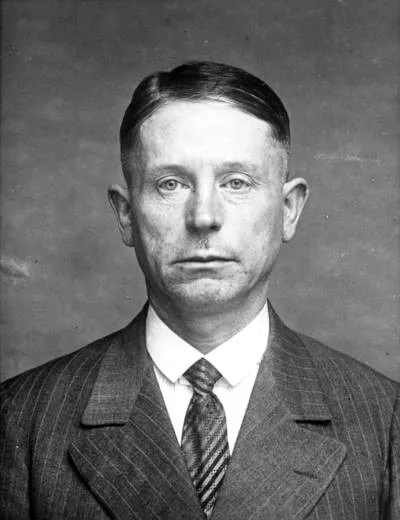
Peter Kürten in a police photograph from April 1931 (cropped to the front view).
Bundesarchiv, Bild 102-11502 / CC BY-SA 3.0 DE / commons.wikimedia.org
15 / 17 / Open questions
What is still missing
- The true number of victims: Kürten’s list of 79 crimes contains further confessed killings, plus the claim about two boys drowned in his childhood and, according to Ossietzky, confessions to crimes from a time when he was in prison.
- Why he confessed to his wife: Kürten spoke of wanting her to collect the reward; according to Berg, his wife claimed that not a word was said about a reward.
- In 1931 Ossietzky voiced the suspicion that someone had hinted to Kürten at clemency in return for cooperation.
- For Maria Hahn, Ida Reuter and Elisabeth Dörrier no two sources agree on the age; the ages of Christine Klein, Rosa Ohliger, Rudolf Scheer and Louise Lenzen differ between sources.
- Mrs Kühn’s first name: Biography.com gives Maria, other sources Apollonia.
- The location of the grave of his body and how the head came to the USA, according to LTO via a collector in Hawaii.
- Discrepancies between sources: the year of birth (1883 or 1882), the number of siblings, the length of his father’s sentence, the amount of the reward and the place of arrest (St. Rochus Church, or Prinz-Georg-Straße according to WEB.DE).
16 / 17 / Citations
Sources
A number in square brackets next to a claim refers to an item in this list. A claim without a number has no source assigned yet. Details may vary between sources; disputed and theoretical items are marked.
18Sources in total
- Primary1
- Secondary12
- Media5
Checked: 17 Nov 2026. Research in one round; the backbone is the book by the forensic doctor Karl Berg (Der Sadist, in English The Sadist 1938) with Kürten’s confession, supplemented by Legal Tribune Online, a 2023 dpa report (t-online and ORF as one source), WEB.DE, the local historian Winfried Steiling, contemporary texts by Ossietzky and Friedländer, and Biography.com (Crime+Investigation has an identical text and is counted with it as one source). Wikipedia served only as a guide and is not among the sources. Names of the nine murdered: Berg and Biography.com count as two sources; where LTO, dpa, WEB.DE or Steiling also give the name, they are cited in preference. Victims’ ages only with two agreeing sources (Hamacher, Albermann); for Klein, Ohliger, Scheer and Lenzen the discrepancy is noted with the date, for Hahn, Reuter and Dörrier the age is missing. Albermann died on 7 Nov 1929; the date 27 Nov in Berg is a typo. Survivors only from the judgment, plus Butlies; names known only from Berg are omitted or described. Code DE-1913-PK: Germany, year of the first murder (Christine Klein, 25 May 1913), initials Peter Kürten. Unavailable: the judgment and the files in the Landesarchiv NRW, the contemporary press in ANNO and the Deutsche Digitale Bibliothek, Britannica. Before publication, verify the victims’ ages, Mrs Kühn’s first name, the date the swan was killed, the place of arrest and the time of the execution.
- [1]Karl Berg (translated by Olga Illner and George Godwin; The Sadist, London, Acorn Press 1938; German original Der Sadist 1931/1932), Internet Archive, The sadist [electronic resource] : Berg, Karl. : Free Download, Borrow, and Streaming : Internet Archive. archive.org / cited 63×primary
- [2]Legal Tribune Online (Martin Rath, 30 Mar 2014), Serienmörder Peter Kürten. lto.de / cited 16×secondary
- [3]Legal Tribune Online (Martin Rath, 30 Mar 2014, p. 2 Ergreifung und Hinrichtung), Kriminalgeschichte: Kürtens Kopf. lto.de / cited 8×secondary
- [4]t-online (dpa, 12 Apr 2023), Unbekannte Akte über den "Vampir von Düsseldorf" aufgetaucht. t-online.de / cited 6×media
- [5]ORF (dpa, 2023), Unbekannter Akt über Serienmörder Kürten aufgetaucht - news.ORF.at. orf.at / cited 1×media
- [6]WEB.DE (Tim Frische, 24 May 2025), Er trinkt das Blut seiner Opfer - und wird nur durch einen Zufall gefasst | WEB.DE. web.de / cited 30×media
- [7]Winfried Steiling (02/2021, ULB Düsseldorf, e-Pflicht), Peter Kürten. Chimäre aus „Jack the Ripper und einem Neandertaler“ am Stadtrand von Erkrath. e-pflicht.ub.uni-duesseldorf.de / cited 28×secondary
- [8]Projekt Gutenberg-DE (Carl von Ossietzky, Der Verrat an Kürten, Die Weltbühne 1931), Sämtliche Schriften 1931-1933 - Carl von Ossietzky. projekt-gutenberg.org / cited 1×media
17 / 17 / Revision history
Revision history
Every edit to this page is logged. Corrections sent in by readers are applied only after the editors check them against sources.
- Published
- Updated
- Edits
- 1
- Page published