01
Content warningReal violent crimes; victims are named. Help: findahelpline.com. More
This page describes real violent crimes and names the victims. Victims come first; we leave out details that serve only sensationalism. Help: free helplines in your country at findahelpline.com; in an emergency call 112 (EU) or 911 (US).
Fritz Haarmann
Friedrich Heinrich Karl Haarmann, born 25 Oct 1879, Hanover
A petty criminal, dealer in second-hand clothes and police informant from Hanover. Between September 1918 and June 1924 he picked out boys and young men at the main railway station, invited them to his lodgings and killed them there. He dismembered the bodies and threw the remains mainly into the river Leine. Human skulls found in the river from May 1924 onwards put the police on his trail. He was arrested on the night of 22 Jun 1924 after a quarrel with 15-year-old Kurt Fromm. On 19 Dec 1924 the jury court in Hanover sentenced him to death 24 times for 24 murders; he had been charged with 27. He was executed by guillotine on 15 Apr 1925. The case revealed how long the police had ignored complaints about their own informant.
- 27
- murders charged, from 1918 to 1924● Fact
- 24
- murders of which he was convicted, 24 death sentences● Fact
- 3
- cases in which the court acquitted him● Fact
- 22
- people at least, according to some 500 pieces of remains from the river Leine● Fact
7Fact
6Disputed
1Theory
77 of 77claims have a source
22sources, 3 of them primary
02 / 17 / Timeline
From birth to the cremation of the head
Events: 51 / 1879–2025
- 01
Life
1879–18 - 1886Easter
School
LifeHe started at the middle school on Engelbosteler Damm and had to repeat a year twice. Stated only by Lessing. [1]
- 1895April
NCO school
LifeHe entered the NCO school in Neu-Breisach and left at his own request in November 1895. Stated only by Lessing. [1]
- 18976 Feb
Asylum in Hildesheim
LifeHe was transferred for observation of his mental state; the doctors found him mentally ill and the proceedings were dropped. Stated only by Lessing. [1]
- 1900October
Military service
LifeHe joined Jägerbataillon 10. Stated only by Lessing. [1]
- 19015 Apr
Death of his mother
LifeHis mother Johanne, née Claudius, died. Stated only by Lessing. [1]
- 1913
Five years’ penal servitude
LifeFor thefts from cellars he received five years’ penal servitude. According to Lessing he served them in Celle, Lüneburg, Rendsburg and Rawitsch. [1]
- 02
Crimes
1918 - 03
Capture, trial, execution
1918–19 - 1919April
Nine months in prison
Capture, trial, executionFor the case of October 1918 he received nine months in prison. Stated only by Lessing. [1]
- 04
Life
1919–21 - 25 Dec
Death of his father
LifeHis father died at the age of 76. Stated only by Lessing. [1]
- 05
Crimes
1923 - 06
Life
1923 - 07
Crimes
1923 - 08
Life
1923 - 09
Crimes
1923–24 - 10
Capture, trial, execution
1924 - 11
Crimes
1924 - 12
Capture, trial, execution
1924 - 13
Crimes
1924 - 14
Capture, trial, execution
1924–25 - 8 Jul
Police press release
Capture, trial, executionThe police described the victims’ milieu as the most depraved proletariat. Residents of the Altstadt protested against this. Stated only by Kompisch. [7]
- 202422 Jun
100 years since the arrest
Capture, trial, executionFor the anniversary, the police museum in Nienburg shows a replica of the cell. Stated only by dpa. [13]
03 / 17 / Victims first
Named victims
Named victims: 24 / Survivors: 3
The list contains the 24 boys and young men for whose murder Haarmann was convicted on 19 Dec 1924. The names come from Lessing’s list of the 27 cases charged and from the fonds description in the Niedersächsisches Landesarchiv. The dates are dates of disappearance; the exact days are given only by Lessing, the month is also confirmed by the archive. The place is the flat where Haarmann was living at the time; this is inferred from the addresses, and the sources do not document it separately for individual victims. The age is given only where both sources agree. It is left out for Ehrenberg (13 or 14), Bronischewski (17 or 15) and Heinrich Koch (18 or 20), and also for Sonnenfeld, Hannappel, Senger, Hogrefe and Abeling, where Lessing contradicts himself between the date of birth and the age in the text. Abeling was the youngest victim, aged 10 or 11.
Showing 12 of 24
- Friedel Rotheflat at Celler Straße 27, Hanover-Oststadt, Hanover (Prussian Province of Hanover, now Lower Saxony)25 Sep 1918age 17
- Fritz Frankeroom at Neue Straße 8, Hanover, Hanover (Prussian Province of Hanover, now Lower Saxony)12 Feb 1923age 16
- Wilhelm Schulzeroom at Neue Straße 8, Hanover, Hanover (Prussian Province of Hanover, now Lower Saxony)20 Mar 1923age 16
- Roland Huchroom at Neue Straße 8, Hanover, Hanover (Prussian Province of Hanover, now Lower Saxony)23 May 1923age 15
- Hans Sonnenfeldroom at Neue Straße 8, Hanover, Hanover (Prussian Province of Hanover, now Lower Saxony)late May 1923age unknown
- Ernst Ehrenbergroom at Neue Straße 8 or attic room at Rote Reihe 2, Hanover (the month of the move), Hanover (Prussian Province of Hanover, now Lower Saxony)25 Jun 1923age unknown
- Heinrich Strußattic room at Rote Reihe 2, Hanover, Hanover (Prussian Province of Hanover, now Lower Saxony)24 Aug 1923age 18
- Paul Bronischewskiattic room at Rote Reihe 2, Hanover, Hanover (Prussian Province of Hanover, now Lower Saxony)24 Sep 1923age unknown
- Richard Gräfattic room at Rote Reihe 2, Hanover, Hanover (Prussian Province of Hanover, now Lower Saxony)late September 1923age 17
- Wilhelm Erdnerattic room at Rote Reihe 2, Hanover, Hanover (Prussian Province of Hanover, now Lower Saxony)12 Oct 1923age 16
- Heinz Brinkmannattic room at Rote Reihe 2, Hanover, Hanover (Prussian Province of Hanover, now Lower Saxony)27 Oct 1923age 13
- Adolf Hannappelattic room at Rote Reihe 2, Hanover, Hanover (Prussian Province of Hanover, now Lower Saxony)11 Nov 1923age unknown
By location
Hanover (Prussian Province of Hanover, now Lower Saxony)24
Victim profile
12 and under0
13–1714
18–242
25 and over0
Women and girls: 0 / Men and boys: 24 (of 24 named)
Survivors
- Kurt Frommaged 15, in state care; from 18 Jun 1924 Haarmann kept him in the flat for several days and abused him. His statement at the station police post on 22 Jun 1924 led to the arrest
- Fritz Kahlmeyeraged 14, a friend of Robert Witzel, abused by Haarmann. After the arrest he testified about Witzel. Stated only by Lessing
- Boy from the bathsaged 13; in February 1923 a doctor reported to the police that Haarmann had molested him in the public baths. Unnamed because of medical confidentiality; the police did not investigate. Stated only by Kompisch
Unconfirmed
In three of the cases charged the court acquitted him: Hermann Wolf (aged 14 or 15, disappeared at the station on 24 or 25 Oct 1923), Adolf Hennies (aged 19, disappeared on 6 Dec 1923; Haarmann accused Grans and his friend Hugo Wittkowski of the murder) and Hermann Bock (aged 22, a long-standing acquaintance, disappeared in mid-April 1924). According to Lessing, in 1918 Haarmann was also suspected in the disappearance of the 14-year-old schoolboy Hermann Koch, and in 1908 in the disappearance of two schoolboys; he was not charged with these. NDR gives more than 30 victims, and the director of the police museum in Nienburg, Dirk Götting, considers the true number to be higher than 24. The contemporary press wrote of up to twice as many, one communist speaker of 168. The estimate of 50 to 70 victims, which Haarmann himself is said to have given, appears only in Deník.
04 / 17 / Offender’s pattern
What recurred
Haarmann left no messages or signs. His pattern consists of hunting at the railway station, his flat as the crime scene, selling the victims’ clothes and the cover that his work with the police gave him. Each item is marked as a documented fact, a disputed point or a theory.
Traits: 7
02
Food and a bed
● Fact03
Killing in the flat
● Fact04
Dismemberment and the river
● Fact05
The victims’ clothes
● Fact06
Selling meat
◐ Disputed07
Cover as an informant
● Fact05 / 17 / Modus operandi
How the behaviour evolved
Phases: 3
1879-1918
Before the murders
Childhood in Hanover, psychiatric asylums, the army and long sentences for theft and fraud.
- 1896: first criminal proceedings for sexual offences against children
- 1897: asylum in Hildesheim, escape from Langenhagen to Switzerland
- 1900 to 1902: military service, discharged as an invalid
- 1913: five years’ penal servitude
- April 1918: released, a small shop at Celler Straße 27
1918-1924 / Hanover
Murders
The first case charged dates from September 1918, the main series from February 1923 to June 1924.
- 25 Sep 1918: Friedel Rothe disappeared
- 1919: met Hans Grans
- 1921 to 1923: room at Neue Straße 8
- from June 1923: attic room at Rote Reihe 2
- February 1923 to June 1924: 26 further cases charged
- May to June 1924: skulls in the Leine
From 22 Jun 1924
Capture, trial, execution
Arrested after a quarrel with a youth at the station, he confessed a week later.
- 22 Jun 1924: arrest
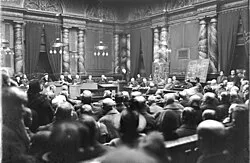
- 4 to 19 Dec 1924: trial, 24 death sentences
- 15 Apr 1925: execution
- 1926: Grans’s retrial
- 2014: cremation of the head
06 / 17 / Crime scenes
Where and in what order
Places: 4
map of crime scenes (points by date and place) / add from coordinates
- 01Hanover, Celler Straße 271918
- 02Hanover, Neue Straße 81921-1923
- 03Hanover, Rote Reihe 21923-1924
- 04Göttingen, Institute of Forensic Medicine (the head)1925-2014
07 / 17 / Investigation
How he was caught
Steps: 7
01 / 1918
Report by Rothe’s mother
The police searched the flat in Celler Straße but did not find Friedel Rothe. Haarmann later claimed that his head had been lying in the flat at the time. [1] [7] [9]
02 / 1918-1924
Police informant
Haarmann helped the police uncover forgers and thieves and was in daily contact with police officers. Complaints about him got lost. [1] [15]
03 / May to June 1924
Skulls in the Leine
Human skulls were found on the riverbank. A search by volunteers turned up hundreds of pieces of remains of at least 22 people. [1] [7] [8] [17]
04 / 22 Jun 1924
Arrest
At the station Haarmann quarrelled with Kurt Fromm and both ended up at the station police post. The police used this to arrest him and search the flat at Rote Reihe 2. [1] [8] [14]
05 / summer 1924
Display of clothes
The police put on display clothing and items from the flat and from acquaintances. From them, parents recognised their missing sons. [1] [7] [8]
What went wrong
- Complaints without responseReports from neighbours and parents went unaddressed for years. According to Lessing, Robert Witzel’s parents went to the police seventeen times, and between their first report and the arrest five more young men died.
- The 1918 searchThe police found nothing in the flat, although according to Haarmann Friedel Rothe’s head was there.
- Ignored reportsAccording to Kompisch, a landlady’s report from 1922 and a doctor’s report from 1923 had no consequences. The police themselves stated that of the 24 victims only 10 had been reported missing.
- Abuse during interrogationsHaarmann was beaten and abused during interrogations. Part of his testimony against Grans, which he later retracted, also rested on this.
- Insulting the familiesIn a press release the police described the victims’ milieu as the most depraved proletariat. According to Kompisch, most of the victims in fact had a job, went to school or were apprentices.
Impact on forensics and law
- Debate on the death penaltyAccording to Kompisch, the case fuelled the debate on the death penalty, diminished responsibility and the criminalisation of homosexuality under Paragraph 175. The sources do not document any specific change in the law or in police practice.
- A figure of the city’s memoryHaarmann became a figure of Hanover folklore. The song “Warte, warte nur ein Weilchen” has circulated since 1924, the case has been treated in films, theatre and a comic, and it returned to the media for the centenary.
08 / 17 / People in the case
Witnesses, investigators, relatives
People: 14
Partner, co-defendant
Hans Grans
Born 7 Jul 1901, 21 years younger. In 1924 sentenced to death for incitement; in the 1926 retrial sentenced to 12 years’ penal servitude for knowing complicity.
Survivor
Kurt Fromm
The 15-year-old boy whose quarrel with Haarmann at the station led to the arrest.
Presiding judge
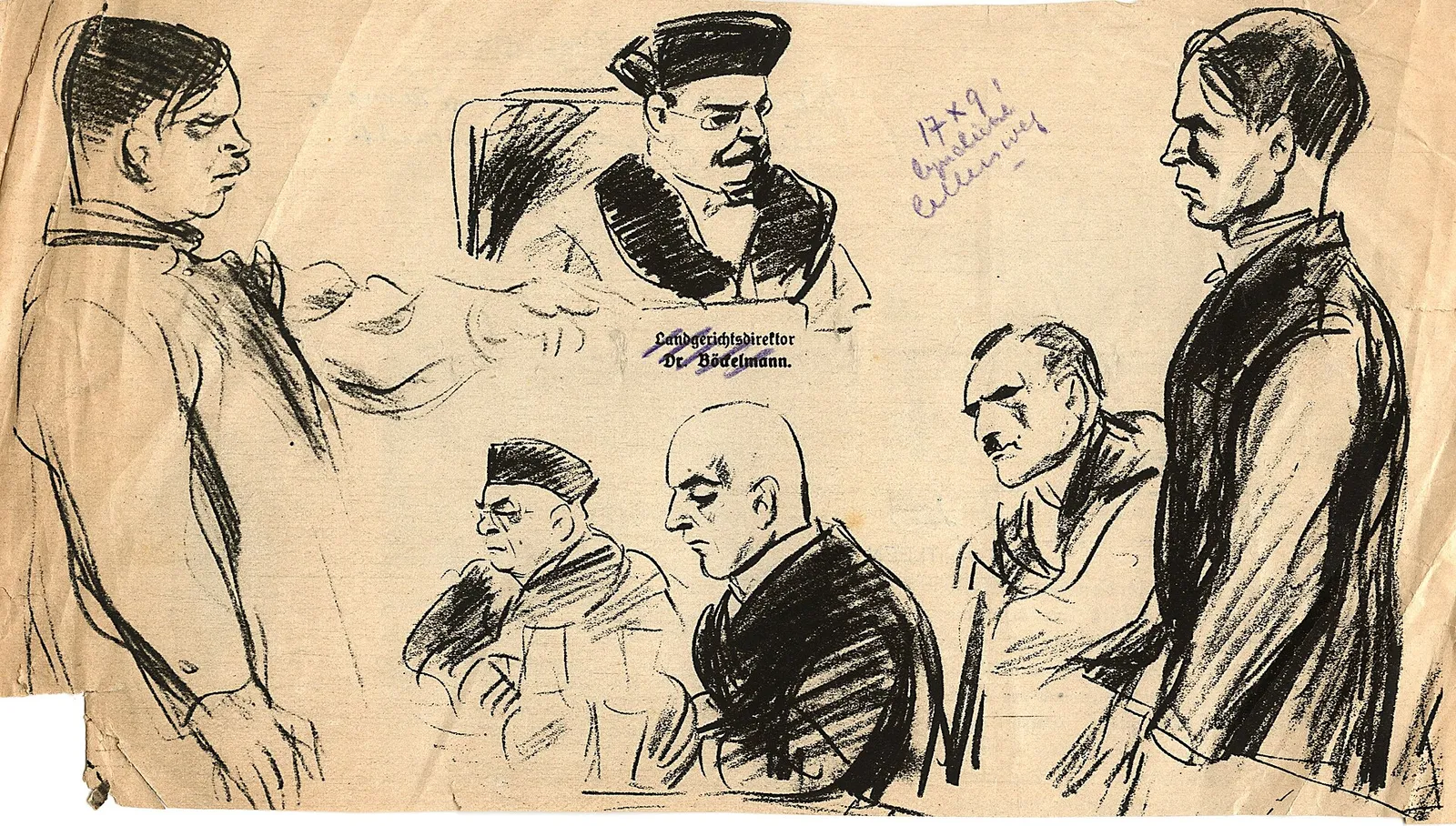
Dr. Bökelmann
Landgerichtsdirektor, presided over the 1924 trial and, according to taz, interrupted testimony critical of the police.
Senior public prosecutor
Dr. Wilde
Prosecuted 27 murders and refused to postpone the trial.
Defence counsel
Justizrat Benfey
Haarmann’s court-appointed defence counsel. Stated only by Lessing.
Expert
Prof. Ernst Schultze
Psychiatrist from Göttingen, found Haarmann criminally responsible. His conversations with him were published as the “Haarmann-Protokolle”.
Accomplices: in 1924 the court sentenced Hans Grans to death for incitement to murder. Haarmann then retracted these accusations in a letter, and in the 1926 retrial Grans was convicted only of knowing complicity. No one attributes a murder by his own hand to him.
09 / 17 / Trial and sentence
From trial to execution
Proceedings: 5
4 to 19 Dec 1924 / Schwurgericht Hannover
Main trial
Jury court with presiding judge Bökelmann, two associate judges and six jurors. The indictment covered 27 murders. In three cases (Wolf, Hennies, Bock) the court acquitted Haarmann. Haarmann accepted the verdict. [2] [5] [8] [14]
24 death sentences
19 Dec 1924 / Schwurgericht Hannover
Hans Grans
Grans was sentenced to death for incitement to murder and to 12 years for aiding. Lessing relates this to the Hannappel and Wittig cases in that order, taz the other way round. [5] [14]
Death sentence
February 1925 / Reichsgericht
Grans’s appeal
The Reichsgericht dismissed Grans’s appeal on points of law. Shortly afterwards Haarmann’s letter clearing Grans was found. [6] [14]
Dismissed
15 Apr 1925 / Hanover
Execution
Haarmann was executed by guillotine. The exact place and the name of the executioner are not documented by two independent sources. [8] [10] [11] [14]
Executed
From 12 Jan 1926 / Schwurgericht Hannover
Grans’s retrial
Grans was now tried only for knowing complicity. According to taz, a police officer admitted at the trial that he had beaten Haarmann with a hose. [14] [8] [16]
12 years’ penal servitude
Execution
Haarmann was executed by guillotine in Hanover on 15 Apr 1925. The sources differ on his last meal: according to taz cheese, bread with ham and cigars, according to Deník Brazilian coffee and a cigar.
The head in Göttingen
For almost 90 years the head was kept in formalin at the Göttingen Institute of Forensic Medicine. It was last shown publicly in the early 1960s. In March 2014 the university hospital cremated it and buried the urn anonymously in Göttingen.
The victims’ grave
The victims’ remains lie in a common grave at Stöcken Cemetery in Hanover; they were buried on 21 Feb 1925. A granite memorial was erected there in April 1928.
Hans Grans
Grans served his sentence in the penitentiary in Celle and was then held in Sachsenhausen concentration camp. After the war he lived in Hanover under another name. According to the archive he died in 1975; taz writes of the early 1980s.
10 / 17 / Unidentified perpetrator
Suspects and identity claims
None of these names has been confirmed by a court. We list them only to make clear what was claimed and what the authorities said.
Hans Grans
◐ DisputedThe 1924 verdict made him the instigator of two murders because he wanted the victims’ clothes. It rested on Haarmann’s statements, which Haarmann retracted in a letter and attributed to abuse. In 1926 Grans was convicted only of knowing complicity. [5] [6] [14]
Hugo Wittkowski
◐ DisputedA friend of Grans whom Haarmann accused of the murder of Adolf Hennies. He came forward to the court himself. Stated only by Lessing. [2] [3]
11 / 17 / Psychology and myths
What is documented and what is not
Items: 7 / each labelled Fact, Disputed or Theory
He sold the victims’ flesh
◐ DisputedThis is still told today, and Deník presents it as fact. According to NDR and dpa it was never proven; Lessing writes that the matter remained uncertain. [17] [8] [11] [1]
Convicted of 27 murders
◐ DisputedDeník gives 27 murders convicted. In fact 27 murders were charged and he was convicted of 24. [17] [5] [16]
The victims were vagrants and prostitutes
◐ DisputedThat is how the police portrayed the victims in 1924. According to Kompisch and the list of occupations in the archive, most of them went to school, were apprentices or worked. [7] [16]
Grans as instigator
◐ DisputedThe 1924 verdict rested on statements that Haarmann retracted. In the retrial the court did not convict Grans of incitement. [6] [14]
The song about Haarmann
● FactThe song “Warte, warte nur ein Weilchen”, to the tune of a hit by Walter Kollo, circulated from 1924 in several versions of the lyrics. [7] [8] [14] [15]
Rothe’s head in a suitcase
◐ DisputedThe City of Hanover writes that Friedel Rothe’s head was in a suitcase during the 1918 search. Kompisch, citing the records, gives the place as behind the stove. [9] [7]
Model for Biberkopf and the film M
○ TheoryHaarmann is often named as one of the inspirations for Lang’s film M and for the character Franz Biberkopf. This is an interpretation, not a documented fact. [7] [8]
12 / 17 / Comparison
Related cases
1972-1978 / USA
John Wayne Gacy
33 victims / Executed 1994
In common
Both lured boys and young men to their homes and killed them there. Both were executed.
Difference
Gacy buried most of the bodies under his house near Chicago. Haarmann threw the remains into the river and, as an informant, was in daily contact with the police.
1978-1990 / USSR
Andrei Chikatilo
52 proven victims / Executed 1994
In common
A long series of young victims, police failures and execution.
Difference
Chikatilo killed in the USSR from 1978 to 1990, outdoors, mainly women and children of both sexes. Haarmann killed boys and young men in his flat in Hanover.
13 / 17 / Books and films
Treatments of the case
The label is an editorial rating: Recommended means a balanced treatment with verifiable sources; With caution means the work gives the perpetrator a platform or opts for a simplified version.
Book / 1925Recommended
Haarmann. Die Geschichte eines Werwolfs
Theodor Lessing, an eyewitness to the trial. Contemporary and in places journalistic, freely available on Projekt Gutenberg.
Book / 1992Source
Haarmann. Nachruf auf einen Werwolf
Friedhelm Werremeier, with the memoirs of the detective Lange.
Book / Source
Haarmann-Protokolle
Conversations of the psychiatrist Ernst Schultze with Haarmann, edited by Christine Pozsár and Michael Farin.
Academic thesis / 2008Recommended
Wüstling - Werwolf - Teufel
Dissertation by Anne-Kathrin Kompisch on the image of serial killers in the German press 1918-1945.
14 / 17 Photos and documents
Photos and documents10
Photos and documents from readers. We publish them after review; you see your own uploads straight away, marked Pending review.
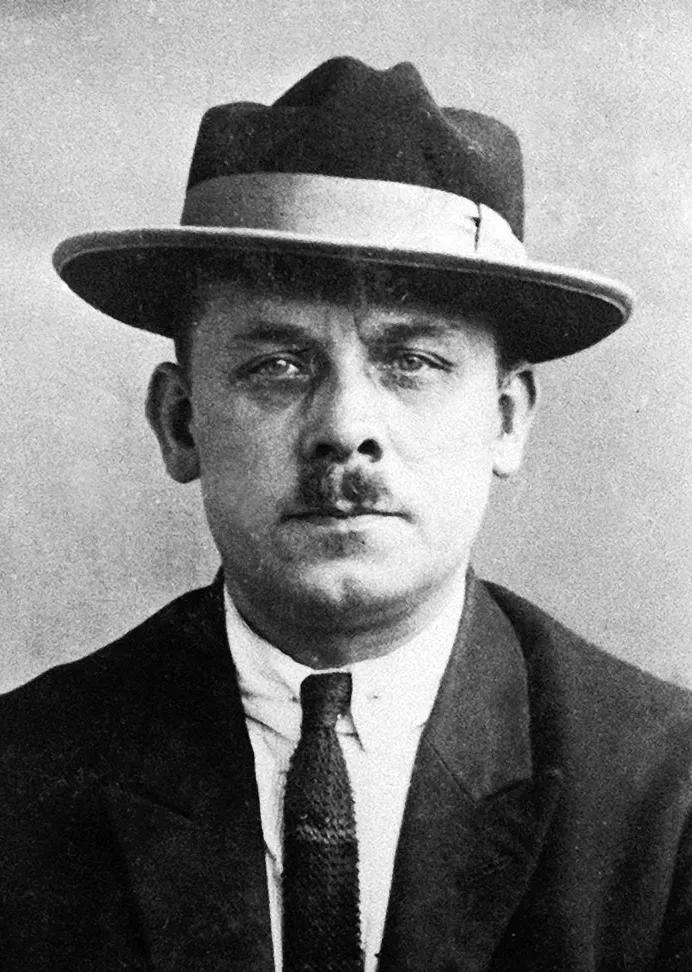
About this image
- Original title
- fritz-haarmann-dobovy-portret-v-klobouku.jpg
- Author
- Wikimedia Commons, reprodukce s nedoloženým autorem
- Source
- commons.wikimedia.org
- Licence
- © All rights reserved
- Changes
- resized, converted to AVIF and WebP, metadata removed
Black-and-white portrait of Fritz Haarmann wearing a hat.
Wikimedia Commons, reprodukce s nedoloženým autorem / © All rights reserved / commons.wikimedia.org
About this image
- Original title
- Bundesarchiv Bild 102-00824, Hannover, Prozeß gegen Friedrich Haarmann.jpg
- Author
- Bundesarchiv, Bild 102-00824 / Georg Pahl
- Source
- commons.wikimedia.org
- Licence
- CC BY-SA 3.0 DE
- Changes
- resized, converted to AVIF and WebP, metadata removed
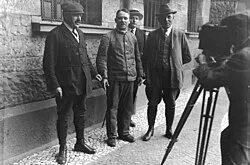
Fritz Haarmann among detectives in front of a camera in Hanover in November 1924.
Bundesarchiv, Bild 102-00824 / Georg Pahl / CC BY-SA 3.0 DE / commons.wikimedia.org
About this image
- Original title
- Bundesarchiv Bild 102-00826, Hannover, Prozeß gegen Friedrich Haarmann.jpg
- Author
- Bundesarchiv, Bild 102-00826 / Georg Pahl
- Source
- commons.wikimedia.org
- Licence
- CC BY-SA 3.0 DE
- Changes
- resized, converted to AVIF and WebP, metadata removed
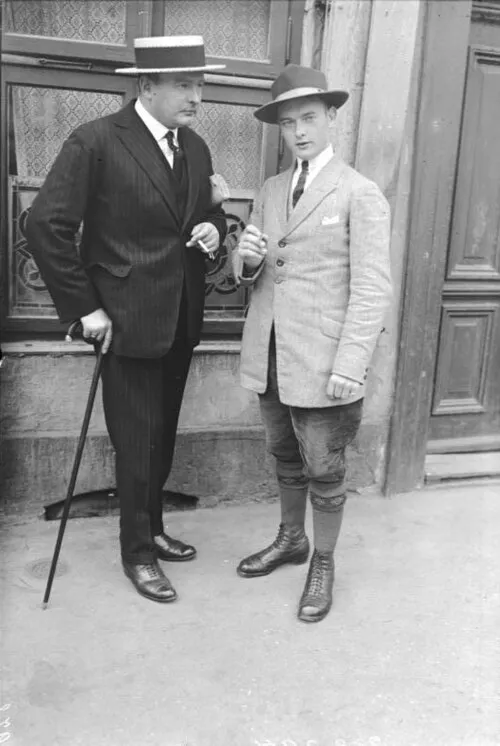
Two men connected with the Haarmann trial in Hanover. On the right is the witness Theodor Hartmann.
Bundesarchiv, Bild 102-00826 / Georg Pahl / CC BY-SA 3.0 DE / commons.wikimedia.org
About this image
- Original title
- Bundesarchiv Bild 102-00881, Hannover, Prozeß gegen Friedrich Haarmann.jpg
- Author
- Bundesarchiv, Bild 102-00881 / Georg Pahl
- Source
- commons.wikimedia.org
- Licence
- CC BY-SA 3.0 DE
- Changes
- resized, converted to AVIF and WebP, metadata removed
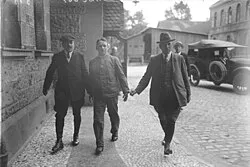
An escort leads Fritz Haarmann to a court hearing in Hanover.
Bundesarchiv, Bild 102-00881 / Georg Pahl / CC BY-SA 3.0 DE / commons.wikimedia.org
About this image
- Original title
- Bundesarchiv Bild 102-00922, Hannover, Prozeß gegen Friedrich Haarmann.jpg
- Author
- Bundesarchiv, Bild 102-00922 / Georg Pahl
- Source
- commons.wikimedia.org
- Licence
- CC BY-SA 3.0 DE
- Changes
- resized, converted to AVIF and WebP, metadata removed
The courtroom as the verdict was delivered in Hanover on 19 December 1924.
Bundesarchiv, Bild 102-00922 / Georg Pahl / CC BY-SA 3.0 DE / commons.wikimedia.org
About this image
- Original title
- Bundesarchiv Bild 102-00544, Hannover, Wohnhaus des Mörders Friedrich Haarmann.jpg
- Author
- Bundesarchiv, Bild 102-00544 / Georg Pahl
- Source
- commons.wikimedia.org
- Licence
- CC BY-SA 3.0 DE
- Changes
- resized, converted to AVIF and WebP, metadata removed
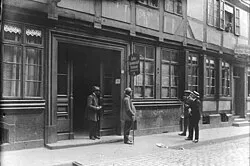
View of the house linked to the Haarmann case in Hanover, July 1924.
Bundesarchiv, Bild 102-00544 / Georg Pahl / CC BY-SA 3.0 DE / commons.wikimedia.org
About this image
- Original title
- Bundesarchiv Bild 102-00882, Hannover, Prozeß gegen Friedrich Haarmann.jpg
- Author
- Bundesarchiv, Bild 102-00882 / Georg Pahl
- Source
- commons.wikimedia.org
- Licence
- CC BY-SA 3.0 DE
- Changes
- resized, converted to AVIF and WebP, metadata removed
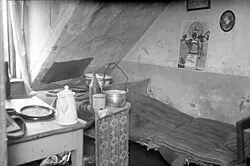
Haarmann's attic room in a period archive photograph from December 1924.
Bundesarchiv, Bild 102-00882 / Georg Pahl / CC BY-SA 3.0 DE / commons.wikimedia.org
About this image
- Original title
- fritz-haarmann-evidencni-vyrez-grans-haarmann.jpg
- Author
- Bundesarchiv, Bild 102-02193, autor neuveden
- Source
- bild.bundesarchiv.de
- Licence
- © All rights reserved
- Changes
- resized, converted to AVIF and WebP, metadata removed
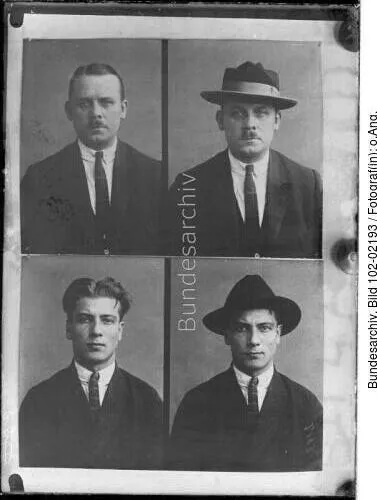
Period press photograph with four police portraits of Hans Grans and Fritz Haarmann.
Bundesarchiv, Bild 102-02193, autor neuveden / © All rights reserved / bild.bundesarchiv.de
About this image
- Original title
- fritz-haarmann-soudni-kresby-1924.jpg
- Author
- Spaarnestad Photo / Nationaal Archief, SFA022819448
- Source
- commons.wikimedia.org
- Licence
- © All rights reserved
- Changes
- resized, converted to AVIF and WebP, metadata removed
A set of court drawings from the Haarmann trial in Hanover in 1924.
Spaarnestad Photo / Nationaal Archief, SFA022819448 / © All rights reserved / commons.wikimedia.org
About this image
- Original title
- Bundesarchiv Bild 102-06186, Hannover, Mörder Haarmann nach Urteilsverkündung.jpg
- Author
- Bundesarchiv, Bild 102-06186 / Georg Pahl
- Source
- commons.wikimedia.org
- Licence
- CC BY-SA 3.0 DE
- Changes
- resized, converted to AVIF and WebP, metadata removed
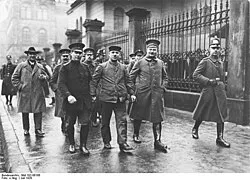
Fritz Haarmann accompanied by guards after the verdict in December 1924.
Bundesarchiv, Bild 102-06186 / Georg Pahl / CC BY-SA 3.0 DE / commons.wikimedia.org
15 / 17 / Open questions
What is still missing
- The true number of victims: 24 convicted, 27 charged, more than 30 according to NDR, or more. According to the City of Hanover he confessed to 9 crimes, admitted 12 more and denied 6.
- What part Hans Grans played in the murders and which two cases the court attributed to him in 1924.
- Criminal responsibility: the experts found him responsible in 1924, earlier assessments regarded him as mentally ill, and the psychiatrist Christine Pozsár questions his criminal responsibility.
- The exact dates of the murders: only the dates of disappearance are known. The ages of several victims differ between sources.
- Where exactly he was executed and who the executioner was. The executioner’s name is given only by Wikipedia.
- The date of Grans’s death (1975 or the early 1980s).
- The files of the Niedersächsisches Landesarchiv and the contemporary press were not read during the research; the description of the archival fonds comes only from a machine extract of the page.
16 / 17 / Citations
Sources
A number in square brackets next to a claim refers to an item in this list. A claim without a number has no source assigned yet. Details may vary between sources; disputed and theoretical items are marked.
22Sources in total
- Primary3
- Secondary11
- Media8
Checked: 17 Nov 2026. Research in one round, 22 sources read. The six chapters of Lessing’s book count as one source, and so do the dpa texts. Every item marked as fact has at least two sources; information from a single source is marked in the text. The fonds description of the Niedersächsisches Landesarchiv was read only through a machine extract, so the victims’ ages are given only where it agrees with Lessing. Code DE: the murders took place in Hanover in what was then the Weimar Republic. Wikipedia served only as a guide. Before publication, verify against the NLA archival fonds and the judgment: the victims’ dates of disappearance and ages, the order of the Hannappel and Wittig cases for Grans, the place of execution and the executioner.
- [1]Theodor Lessing (1925), Projekt Gutenberg, ch. 3 Ort und Zeit des Dramas, Haarmann - Theodor Lessing. projekt-gutenberg.org / cited 38×secondary
- [2]Theodor Lessing (1925), Projekt Gutenberg, ch. 4 Der Prozess, Haarmann - Theodor Lessing. projekt-gutenberg.org / cited 2×secondary
- [3]Theodor Lessing (1925), Projekt Gutenberg, ch. 5 27 Mordfälle, Haarmann - Theodor Lessing. projekt-gutenberg.org / cited 6×secondary
- [4]Theodor Lessing (1925), Projekt Gutenberg, ch. 6 Zwischenspiel, Haarmann - Theodor Lessing. projekt-gutenberg.org / cited 3×secondary
- [5]Theodor Lessing (1925), Projekt Gutenberg, ch. 7 Rechtstechnisches, Haarmann - Theodor Lessing. projekt-gutenberg.org / cited 5×secondary
- [6]Theodor Lessing (1925), Projekt Gutenberg, ch. 8 Nachwort, Haarmann - Theodor Lessing. projekt-gutenberg.org / cited 4×secondary
- [7]Anne-Kathrin Kompisch, dissertation, Universität Hamburg (2008), Wüstling - Werwolf - Teufel. Medienbilder von Serienmördern in der deutschen Massenpresse 1918-1945. ediss.sub.uni-hamburg.de / cited 26×secondary
- [8]NDR (Levke Heed), Fritz Haarmann: Der „Schlächter von Hannover“ | ndr.de. ndr.de / cited 34×media
17 / 17 / Revision history
Revision history
Every edit to this page is logged. Corrections sent in by readers are applied only after the editors check them against sources.
- Published
- Updated
- Edits
- 1
- Page published