01
Content warningReal violent crimes; victims are named. Help: findahelpline.com. More
This page describes real violent crimes and names the victims. Victims come first; we leave out details that serve only sensationalism. Help: free helplines in your country at findahelpline.com; in an emergency call 112 (EU) or 911 (US).
H. H. Holmes
Herman Webster Mudgett, born 16 May 1860 or 1861, Gilmanton (New Hampshire)
A physician, pharmacist and swindler from the Chicago neighbourhood of Englewood, born Herman Webster Mudgett. In September 1894 in Philadelphia he killed his accomplice Benjamin Pitezel to collect a 10,000 dollar insurance policy. In October 1894 he killed three of Pitezel’s children: Howard in Irvington near Indianapolis, Alice and Nellie in Toronto. He was arrested in November 1894 in Boston; Philadelphia detective Frank Geyer did not find the children’s bodies until the summer of 1895. He was convicted only of the murder of Pitezel and hanged in Philadelphia on 7 May 1896. Historians attribute nine victims to him, among them five women and girls in Chicago whose deaths were never tried in court. The legend of a “murder castle” with hundreds of murdered World’s Fair guests has not been confirmed.
- 1
- murder he was convicted of and executed for: Benjamin F. Pitezel, Philadelphia 1894● Fact
- 4
- victims from the Pitezel family whose bodies were found and identified● Fact
- 27
- murders in his written confession of April 1896; several of those named were still alive● Fact
- 10,000
- dollars was the insurance on Pitezel’s life, the motive for the only murder tried● Fact
5Fact
7Disputed
3Theory
75 of 75claims have a source
40sources, 3 of them primary
02 / 16 / Timeline
From birth to exhumation
Events: 48 / 1861–2017
- 01
Life
1861–87 - 02
Crimes
1891–93 - 03
Life
1893 - 04
Crimes
1893 - 05
Life
1894 - 06
Crimes
1894 - 07
Capture, trial, execution
1894 - 08
Crimes
1894 - 09
Capture, trial, execution
1894–95 - 10
Life
1895 - 11
Capture, trial, execution
1895–17
03 / 16 / Victims first
Named victims
Named victims: 9 / Survivors: 3
The list contains the nine victims historians attribute to Holmes, in line with the case card. He was convicted only of the murder of Benjamin Pitezel. The deaths of three of Pitezel’s children were documented by the investigation and their bodies were found and identified, but the court did not admit the evidence on them at trial. The five women and girls from Chicago are marked as attributed at the date: they disappeared between 1891 and 1893, their bodies were not identified and no court ever tried their deaths. Age is given only where at least two sources agree. Alice was 14 (other sources 13 or 15), Howard 9 (Omaha Daily Bee 8). The age of Benjamin Pitezel (37) is given only by Geyer, that of Nellie (11) only by Spacing Toronto and that of Pearl Conner (12) only by Biography.com, so they are omitted.
Showing 9 of 9
- Julia ConnerHolmes’s building at the corner of 63rd and Wallace Street, Englewood, Chicago, Chicago, Illinois1891 or 1892 (attributed, not established by a court)age unknown
- Pearl ConnerHolmes’s building at the corner of 63rd and Wallace Street, Englewood, Chicago, Chicago, Illinois1891 or 1892 (attributed, not established by a court)age unknown
- Emeline CigrandHolmes’s building in Englewood, Chicago, Chicago, Illinois1892 or 1893 (attributed, not established by a court)age unknown
- Minnie R. WilliamsChicago, Chicago, Illinois1893 (attributed, not established by a court)age unknown
- Nannie WilliamsChicago, Chicago, Illinois1893 (attributed, not established by a court)age unknown
- Benjamin F. Pitezelhouse at 1316 Callowhill Street, Philadelphia, Philadelphia, Pennsylvania2 Sep 1894 (the only murder he was convicted of; Commonwealth v. Mudgett)age unknown
- Howard Pitezelrented house in Irvington near Indianapolis, Irvington near Indianapolis, IndianaOctober 1894age 9
- Alice Pitezelcellar of a rented house on St. Vincent Street, Toronto, Toronto, Ontario, Canada25 Oct 1894age 14
- Nellie Pitezelcellar of a rented house on St. Vincent Street, Toronto, Toronto, Ontario, Canada25 Oct 1894age unknown
By location
Chicago, Illinois5
Irvington near Indianapolis, Indiana1
Toronto, Ontario, Canada2
Philadelphia, Pennsylvania1
Victim profile
12 and under1
13–171
18–240
25 and over0
Women and girls: 7 / Men and boys: 2 (of 9 named)
Survivors
- Carrie A. Pitezelwidow of Benjamin Pitezel; in November 1894, in the house in Burlington, Vermont, Holmes told her to move dynamite stored in the cellar. Judge Arnold described this as an attempt to kill her in an explosion. After the arrest she was indicted for conspiracy, then released, and testified against Holmes
- Dessie Pitezelthe elder daughter, survived with her mother and the youngest sibling; according to Judge Arnold she was part of a plan to wipe out the whole Pitezel family
- The youngest Pitezel childstayed with the mother and survived; the name could not be traced in the sources
Unconfirmed
Besides the nine attributed victims, other disappearances are blamed on Holmes; none was investigated or proved. In July 1895 the Omaha Daily Bee wrote about a missing neighbour from the building, a Doctor Rusler; only this source mentions him. Emily Van Tassel, Kate Gorky and her daughter and other names are mentioned only by the blog of historian Adam Selzer. The bones police found in the basement of the building in 1895 were never matched to a specific person. Estimates of the total number of victims range from nine to hundreds and are unsupported; see the myths. Names that later turned out to belong to living people are in the myths.
04 / 16 / Offender’s pattern
What recurred
Holmes left no messages or signature. His pattern consists of insurance fraud, false names, rented houses and travelling with separate groups of people who did not know about each other. Each item is marked as a documented fact, a disputed point or a theory.
Traits: 7
02
Chloroform and a staged accident
● FactMedical experts found chloroform in the stomach without irritation of the lining, so it had been given after death or while he was unconscious. A broken bottle of flammable liquid lay beside the body and the chest was burned. The defence argued suicide. [1] [2] [26] [28]
Biography.com writes that he knocked him out and set him on fire; the Philadelphia Inquirer in 2025 that he got him drunk and burned him alive. The court relied on chloroform poisoning.
03
A divided family
● Fact04
Houses rented under a false name
● Fact05
Burning the body in a stove
● Fact06
Gassing in a trunk
◐ DisputedThe press in 1895 and the prosecution claimed that he shut the girls in a trunk with a hole for a tube and let gas into it. The autopsy in Toronto found no signs of violence and did not determine the cause of death. [5] [7] [16]
The Pennsylvania court did not admit the evidence on the children’s deaths at trial.
07
The “murder castle”
○ TheoryPopular texts describe the building at the corner of 63rd and Wallace Street with gas chambers, chutes and the sale of skeletons to medical schools. In the summer of 1895 police found bones and stains there, but some of the reported finds turned out to be fireclay or remained unclear. The sale of skeletons was never proved. [8] [10] [12] [26] [37]
More in the myths.
05 / 16 / Modus operandi
How the behaviour evolved
Phases: 3
1860-1891
Before the murders
Childhood in New Hampshire, medical studies, his first marriage and from 1886 a drugstore in Chicago’s Englewood.
- 1878: marriage to Clara Lovering
- 1884: medical degree in Ann Arbor
- 1886: drugstore on 63rd Street in Englewood
- 1887: bigamous marriage to Myrta Belknap, construction of the building at the corner of 63rd and Wallace Street
1891-1894 / Chicago, Philadelphia, Irvington, Toronto
Murders
In Chicago women and girls from his circle disappear. In 1894 come the insurance fraud and the murder of Pitezel and three of his children.
- 1891 to 1893: disappearance of Julia and Pearl Conner, Emeline Cigrand and the Williams sisters
- 1893: insurance on Pitezel, meeting Georgiana Yoke
- 2 Sep 1894: murder of Pitezel in Philadelphia
- October 1894: murders of Howard in Irvington, Alice and Nellie in Toronto
- November 1894: dynamite in Carrie Pitezel’s house in Burlington
From November 1894
Capture, trial, execution
Arrested in Boston, charged with the murder of Pitezel after the children’s bodies were found, sentenced to death and hanged.
- November 1894: arrest in Boston
- July and August 1895: discoveries in Toronto and Irvington
- October and November 1895: trial and death sentence
- 4 Mar 1896: sentence upheld
- 7 May 1896: execution
06 / 16 / Crime scenes
Where and in what order
Places: 9
map of crime scenes (points by date and place) / add from coordinates
- 01Gilmanton, New Hampshire1860-1878
- 02Ann Arbor, Michigan1884
- 03Englewood, Chicago, Illinois1886-1894
- 04Fort Worth and St. Louis1894
- 05Philadelphia, Pennsylvania1894
- 06Cincinnati, Indianapolis and Irvington, Detroit1894
- 07Toronto, Canada1894
- 08Burlington, Vermont and Boston1894
- 09Moyamensing Prison, Philadelphia1894-1896
07 / 16 / Investigation
How he was caught
Steps: 7
01 / September 1894
A body under a false name
The coroner’s jury did not recognise the death of “Perry” as murder. Fidelity learned that it was the insured Pitezel and paid out the policy after identification by Holmes and Alice. [1] [2]
02 / autumn 1894
A tip from jail
Marion Hedgepeth wrote to the St. Louis police chief that Holmes had told him about the fraud plan. The insurance inspector Gary verified the statement. [2] [13] [25]
03 / November 1894
The Pinkerton agency and Boston
Detectives followed Holmes and arrested him in Boston. A charge of conspiracy to defraud followed. [2] [13] [14] [27]
04 / 1894 to 1895
Shifting stories
Holmes claimed that the body had been substituted, that Minnie Williams had taken charge of the children and that Pitezel had committed suicide. [2] [7]
05 / June to July 1895
Geyer’s journey
Using hotel registers and the children’s letters, Geyer traced their route through Cincinnati, Indianapolis and Detroit to Toronto. There he went round estate agents until a neighbour gave a tip about the house on St. Vincent Street. [2] [6] [32]
What went wrong
- The coroner missed the murderIn September 1894 the coroner’s jury did not rule the death a murder and buried the body under a false name, although the coroner’s physician spoke of chloroform poisoning.
- Insurance paid to a suspectThe insurance company paid the claim on the basis of an identification made by Holmes himself and a fourteen-year-old girl.
- A late search for the childrenAfter the arrest nobody searched for the children for months while Holmes invented his stories. Geyer did not set out until June 1895.
- A chaotic search in ChicagoThe contemporary press wrote that the search of the building was unsystematic. Reported finds were corrected; supposed bones, for example, turned out to be fireclay.
Impact on forensics and law
- Circumstantial evidenceIn his charge to the jury Judge Arnold explained at length the weight of circumstantial evidence. The decision in Commonwealth v. Mudgett also dealt with whether a woman from a bigamous marriage could testify as his wife. Both are reported only by the court decision itself.
- A law named after the caseNo specific law or regulatory change arising from this case could be documented.
08 / 16 / People in the case
Witnesses, investigators, relatives
People: 17
Accomplice and victim
Benjamin F. Pitezel
A carpenter and Holmes’s associate, insured for 10,000 dollars. The only victim whose murder Holmes was convicted of.
Widow
Carrie A. Pitezel
Wife of Benjamin Pitezel and a key prosecution witness. After the arrest indicted for conspiracy, then released.
Wife
Georgiana Yoke
His third, bigamous wife. She testified for the prosecution; the court held the marriage void and admitted her testimony.
Wives
Clara A. Lovering, Myrta Z. Belknap
The first, lawful wife and the second, whom he married bigamously.
Detective
Frank P. Geyer
A Philadelphia police detective. From June 1895 he traced the children’s route and found their bodies in Toronto and Irvington. In 1896 he published a book about the search.
Detective
Alf Cuddy
A Toronto police detective who dug in the cellar on St. Vincent Street with Geyer.
Accomplices: none established by a court for the murders. Pitezel was his accomplice in the insurance fraud, not in the murders. The lawyer Howe and the caretaker Quinlan were suspected but never tried for murder. The court did not verify the statement of the prisoner J. C. Allen about a plan to kill Pitezel.
09 / 16 / Trial and sentence
From indictment to execution
Proceedings: 5
November 1894 to June 1895 / Philadelphia
Conspiracy to defraud the insurance company
A grand jury indicted Holmes, the lawyer Howe and Carrie Pitezel. Holmes pleaded guilty at trial, and sentencing was deferred. Carrie Pitezel was released after seven months. [1] [2] [14]
Guilty plea, sentencing deferred
28 Oct to November 1895 / Court of Oyer and Terminer, Philadelphia County
Murder of Benjamin Pitezel
Judge Arnold, prosecutor George S. Graham, defence attorneys Samuel P. Rotan and William A. Shoemaker. For the first two days Holmes defended himself. The court did not admit the evidence on the children’s deaths. The jury found him guilty of first-degree murder. [1] [2] [15] [16]
Guilty, death sentence
November 1895 / the same court
Motion for a new trial
The court denied the motion. That defence attorney Shoemaker submitted a forged statement about Pitezel’s suicide with it and was charged with subornation of perjury is reported only by the Beatrice Daily Express. [1] [2] [18]
Denied
4 Mar 1896 / Supreme Court of Pennsylvania
Appeal
The court held Georgiana Yoke’s testimony admissible and the prosecutor’s address unobjectionable, and repeated the experts’ finding that Pitezel could not have administered the chloroform himself. The opinion was written by Justice Williams. [1] [2]
Sentence upheld
7 May 1896 / Moyamensing Prison, Philadelphia
Execution
Hanged. On the gallows he denied the Pitezel murders and said that the extent of his wrongdoing lay in the deaths of two women who had died “at my hands as the result of a criminal operation”. [4] [28] [30] [31]
Executed
Last words
According to the Plattsmouth Weekly Journal, he said on the gallows: “the extent of my wrong doing in taking human life consisted in the death of two women, they having died at my hands as the result of a criminal operation”. At the time a criminal operation meant an illegal abortion.
The execution
The Plattsmouth Weekly Journal writes of a broken neck and a heart that still beat faintly for 15 to 20 minutes. Biography.com says that his neck did not break and that he took about 20 minutes to die.
Grave and exhumation
The contemporary press wrote of the coffin being taken to a vault at Mount Moriah Cemetery. The 2017 exhumation found his remains encased in cement in an unmarked grave at Holy Cross Cemetery in Yeadon. The discrepancy could not be explained.
The building
The building at the corner of 63rd and Wallace Street was damaged by fire in August 1895. That the rest was demolished in 1938 and that a post office stands on the site is reported only by Chicagoist.
10 / 16 / Psychology and myths
What is documented and what is not
Items: 8 / each labelled Fact, Disputed or Theory
A death hotel for World’s Fair guests
◐ DisputedIt is commonly said that he killed many visitors to the 1893 World’s Fair in the building. PhillyVoice writes that “it's unclear if he actually killed any such guests”. No victim from among the guests is documented by name. Selzer states on his blog that the hotel never opened. [26] [27] [30] [33] [36] [37]
Up to 200 victims
◐ DisputedHISTORY, WHYY and the Philadelphia Inquirer give up to or over 200 victims. Biography.com writes that “these claims were exaggerated”. Four are documented, and historians attribute nine. [2] [26] [27] [28] [30] [33]
Gas chambers and the sale of skeletons
○ TheoryPopular texts and EBSCO describe gas chambers, chutes and the sale of skeletons to medical schools. The contemporary press announced finds that it then corrected. Biography.com calls the sale of skeletons a rumour. [8] [26] [29] [36]
Confession to 27 murders
◐ DisputedThe written confession of April 1896 also names people who were still alive. On the gallows he then admitted only to the deaths of two women. [4] [19] [20] [26] [27]
Convicted of four murders
◐ DisputedEBSCO and Spacing Toronto write of a conviction for four murders. The indictment concerned only Pitezel, and the court did not admit the evidence on the children’s deaths. [1] [16] [29] [32]
Dr. Holton as the first victim
◐ DisputedEBSCO names a Mrs. Holton as the probable first victim, in 1890. Selzer states on his blog that she lived until 1933. HISTORY writes only of the drugstore owner’s widow who disappeared, without a name. [29] [30] [37]
Gertrude Conner
◐ DisputedThat he confessed to her murder in 1896 is reported only by Adam Selzer’s blog. A telegram from Muscatine, according to which she died of heart disease in 1891, was printed only by the Omaha Daily Bee, and then by mistake as a report on Julia Conner. [9] [37]
Holmes was Jack the Ripper
○ TheoryThe theory, spread by his great-grandson Jeff Mudgett and the series American Ripper, holds that Holmes escaped execution. The 2017 exhumation found his remains, and the DNA matched the family. [27] [33] [34] [35]
11 / 16 / Comparison
Related cases
1972-1978 / USA
John Wayne Gacy
33 victims / Executed 1994
In common
Both killed in Chicago and both were executed.
Difference
Gacy killed 33 young men and boys and was convicted of all of them. Holmes was convicted of only one murder; historians attribute others to him.
1888 / United Kingdom
Jack the Ripper
5 canonical victims / Unidentified
In common
Both are late 19th century offenders surrounded by many legends. One theory even claims they were the same person.
Difference
The Ripper was never identified. Holmes was arrested, convicted and executed, and a 2017 exhumation confirmed his remains.
12 / 16 / Books and films
Treatments of the case
The label is an editorial rating: Recommended means a balanced treatment with verifiable sources; With caution means the work gives the perpetrator a platform or opts for a simplified version.
Book / 1895With caution
Holmes' Own Story
A memoir written in prison. A self-defence without any admission of the murders.
Book / 1896Recommended
The Holmes-Pitezel Case
Detective Frank P. Geyer on the search for the children, with appendices from the court proceedings.
Book / 1994Source
Depraved
Harold Schechter.
Book / 2003Source
The Devil in the White City
Erik Larson. The parallel story of the building of the World’s Fair and of Holmes.
13 / 16 Photos and documents
Photos and documents1
Photos and documents from readers. We publish them after review; you see your own uploads straight away, marked Pending review.
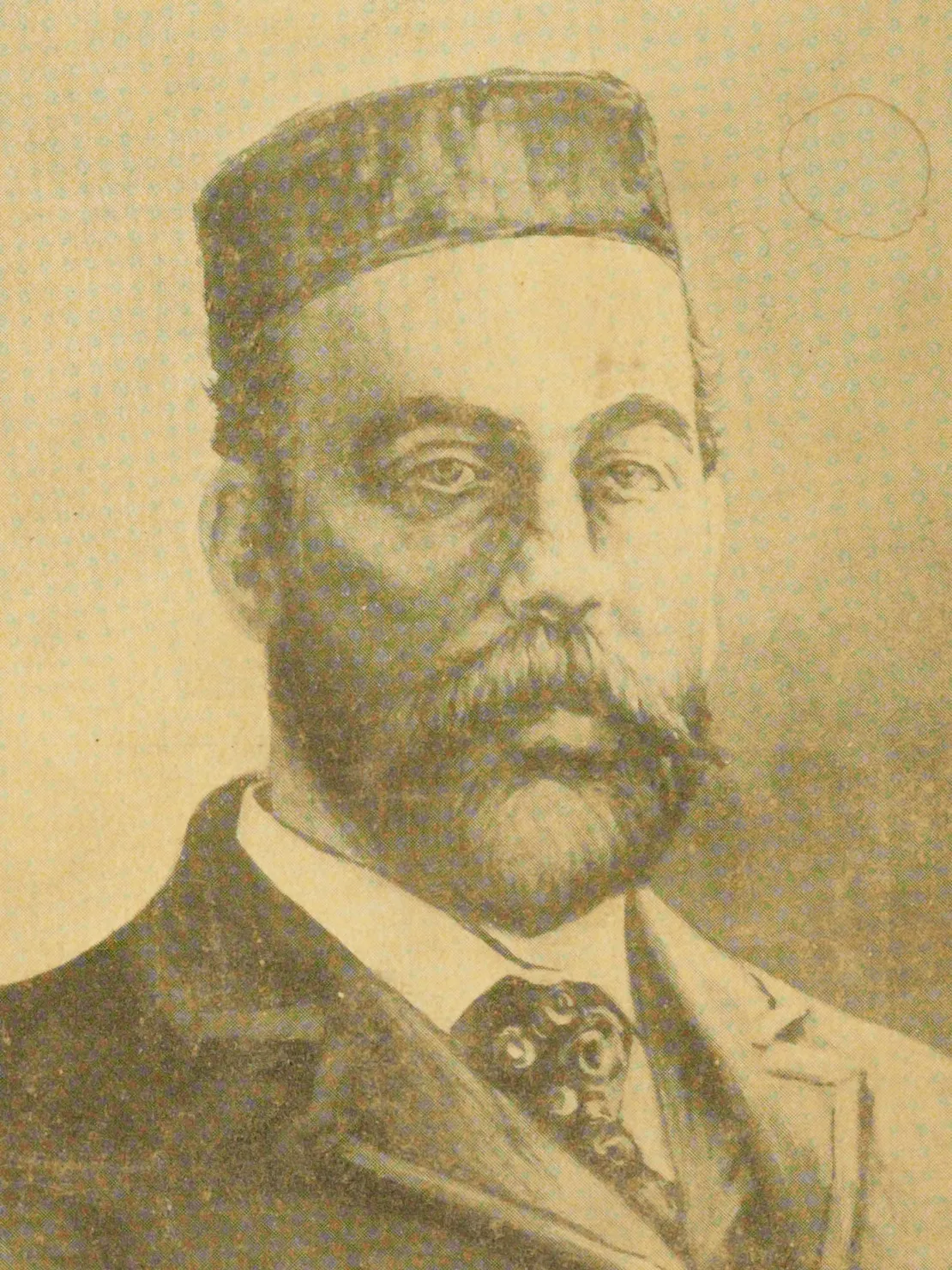
About this image
- Original title
- Holmes' Own Story (Burk & McFetridge Co., Philadelphia, 1895), obálka
- Author
- unknown
- Source
- loc.gov
- Licence
- Public domain
- Changes
- cropped, resized, converted to AVIF and WebP, metadata removed
H. H. Holmes in the portrait on the cover of Holmes' Own Story, published in Philadelphia in 1895 (cropped).
14 / 16 / Open questions
What is still missing
- Exactly how Alice and Nellie died: the autopsy in Toronto did not determine the cause, and the theory of gas in a trunk rests on a hole in the trunk.
- Whether and how the Chicago women and girls died: their bodies were never identified and no court ever tried their deaths.
- Year of birth: 1860 according to Geyer and Chicagoist, 1861 according to Biography.com and his own memoir. Accordingly he was 35 or 34 at his execution.
- Date of the marriage to Georgiana Yoke: 12 Jan 1894 according to Geyer, 14 or 17 Jan 1894 according to the court decision.
- Date of the arrest in Boston: 17 Nov 1894 according to Geyer, “about November 19” according to the court; EBSCO wrongly places the arrest in 1895.
- Ages of the children: Alice 14 according to the court and Geyer, 13 according to the Omaha Daily Bee and Spacing Toronto, 15 according to PhillyVoice; Howard 9 or 8.
- Grave: a vault at Mount Moriah according to the 1896 press, or a grave at Holy Cross in Yeadon according to the 2017 exhumation.
- Who started the fire in the building in August 1895: the press reports an exploding lamp as well as suspected arson.
- The role of the caretaker Quinlan and the lawyer Howe: accused, never tried for murder.
15 / 16 / Citations
Sources
A number in square brackets next to a claim refers to an item in this list. A claim without a number has no source assigned yet. Details may vary between sources; disputed and theoretical items are marked.
40Sources in total
- Primary3
- Secondary7
- Media30
Checked: 17 Nov 2026. All 40 sources were read during research (curl or WebFetch); Wikipedia was not used. Facts have at least two sources; information from a single source, including the court decision or Geyer’s book, is marked in the text with “only … reports” or omitted. Code USA-1891-HH after the first attributed murder: Julia and Pearl Conner disappeared in 1891 (EBSCO, Biography.com), which matches the period 1891-1894 on the card. The five Chicago victims are included among the victims following the Steven Tuomi pattern in the Dahmer profile, because the card counts 9 victims; at the date they carry the note “attributed, not established by a court” (the Siems pattern in the Wuornos profile applies to a victim outside the card count). Geyer and Holmes’s memoir are not impartial sources; Adam Selzer’s blog is a secondary source and is cited only for findings on which of the alleged victims were alive. Before publication, check against the trial record, the Toronto and Chicago press of 1894 to 1896 (Chronicling America was not available) and the text of the April 1896 confession.
- [1]Supreme Court of Pennsylvania (Caselaw Access Project, Harvard Law School, 4 Mar 1896), Commonwealth v. Herman W. Mudgett, alias H. H. Holmes, Appellant (174 Pa. 211). static.case.law / cited 24×primary
- [2]Frank P. Geyer (Philadelphia 1896), scan of the book, Internet Archive, The Holmes-Pitezel case; a history of the greatest crime of the century and of the search for the missing Pitezel children. archive.org / cited 47×primary
- [3]H. H. Holmes (Burk & McFetridge, Philadelphia 1895), the perpetrator’s memoir, Internet Archive, Holmes' Own Story ( 1895). archive.org / cited 6×secondary
- [4]Plattsmouth Weekly Journal (14 May 1896, article “Holmes Is Hanged”), Nebraska Newspapers, Plattsmouth weekly journal. (Plattsmouth, Neb.) 1881-1901, May 14, 1896, Image 3 « Nebraska Newspapers. nebnewspapers.unl.edu / cited 3×media
- [5]Omaha Daily Bee (16 Jul 1895, article “Fate of the Pitzel Girls”), Nebraska Newspapers, Omaha daily bee. (Omaha [Neb.]) 187?-1922, July 16, 1895, Page 3, Image 3 « Nebraska Newspapers. nebnewspapers.unl.edu / cited 2×media
- [6]Omaha Daily Bee (17 Jul 1895, article “Coils Closing on Holmes”), Nebraska Newspapers, Omaha daily bee. (Omaha [Neb.]) 187?-1922, July 17, 1895, Image 1 « Nebraska Newspapers. nebnewspapers.unl.edu / cited 5×media
- [7]Omaha Daily Bee (21 Jul 1895, articles “Holmes Tells His Story” and “Identifies the Bodies”), Nebraska Newspapers, Omaha daily bee. (Omaha [Neb.]) 187?-1922, July 21, 1895, Part I, Page 2, Image 2 « Nebraska Newspapers. nebnewspapers.unl.edu / cited 5×media
- [8]Omaha Daily Bee (22 Jul 1895), Nebraska Newspapers, Omaha daily bee. (Omaha [Neb.]) 187?-1922, July 22, 1895, Image 1 « Nebraska Newspapers. nebnewspapers.unl.edu / cited 4×media
16 / 16 / Revision history
Revision history
Every edit to this page is logged. Corrections sent in by readers are applied only after the editors check them against sources.
- Published
- Updated
- Edits
- 1
- Page published